
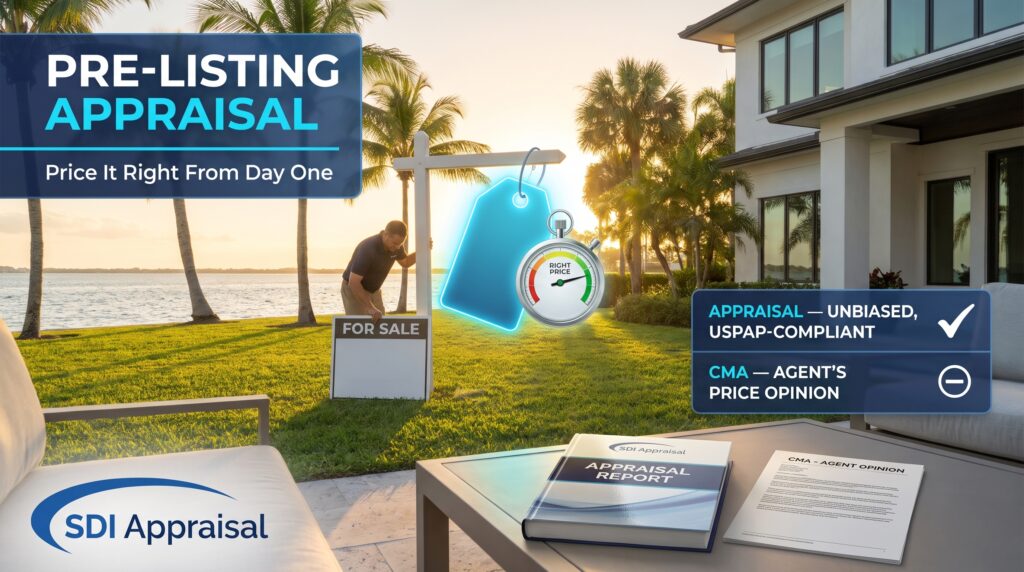
An unbiased, USPAP-certified opinion of value before your home hits the market — what it is, how it differs from a CMA, when it makes sense, and why it matters most for the luxury and waterfront homes of Bradenton, Sarasota, and the Florida Gulf Coast.
“Price a home right from the first day on market, and almost everything else in the sale gets easier.”
One of the most common questions sellers and agents ask is whether it makes sense to have a home appraised before it goes on the market. It is a fair question, and the honest answer is that it depends on the property and the situation. Setting the list price is one of the most consequential decisions in any sale — and on the Florida Gulf Coast, where so many homes are singular, that decision is rarely simple. This guide walks through what a pre-listing appraisal is, how it differs from the tools you may already be using, what it is not, and when it earns its place in your strategy.
The BasicsSo, what exactly is a pre-listing appraisal?
A pre-listing appraisal — sometimes called a pre-sale appraisal — is a professional, unbiased opinion of a home's market value, prepared by a licensed or certified appraiser and ordered by the seller or their agent before the home is listed. It is not done for a bank or a lender. It is done for the benefit of the person selling the home.
The process mirrors any other residential appraisal. The appraiser inspects the property, measures the home, photographs it, researches recent comparable sales and current competing listings, and arrives at a supported opinion of value. The difference is timing and purpose: this report exists to help you price accurately and negotiate with confidence, grounded in what is actually happening in today's market rather than in hope, habit, or an online estimate.

A CMA suggests a price. An appraisal supports one — with documented comparables, supported adjustments, and a methodology that holds up under scrutiny.
Know the DifferencePre-listing appraisal vs. CMA, BPO & online estimates
A pre-listing appraisal is often confused with a Comparative Market Analysis (CMA), and the distinction matters. A CMA is a valuable tool that most agents prepare to suggest a list price, and there is nothing wrong with one. But a CMA is produced by an agent, while an appraisal is produced by a licensed or certified appraiser who follows defined standards — selecting comparables and making adjustments according to a consistent, defensible methodology. The two can land on similar numbers, but they are not the same instrument.
Online value estimates (the automated "Zestimate" style of tool) are convenient, but they run on algorithms and public data and cannot see your custom finishes, your renovation quality, or the precise premium of your waterfront position. The further a home sits from "average," the less reliable those estimates become — which is exactly the case for most luxury and waterfront homes.
| Appraisal | CMA | Online Estimate | |
|---|---|---|---|
| Prepared by | Licensed / certified appraiser | Real estate agent | Automated algorithm |
| Standards | USPAP — uniform, documented | Agent's own approach | Proprietary data model |
| Property visit | Yes — interior & measurement | Usually | No |
| Best for | Unique, luxury & hard-to-value homes | Typical homes in active markets | A rough starting point only |
The Case For OneWhy a seller or agent would want one
The most obvious reason is pricing. Price too high and buyers pass; the home lingers, people begin to wonder what is wrong with it, and the eventual price cut often lands below where a correct price would have started. Price too low and you leave equity on the table. A pre-listing appraisal removes much of that guesswork by giving you a data-driven opinion of value before you commit to a number.
It is also a powerful negotiation tool. When a low offer arrives, you can point to an independent, third-party report. And because you have already done the homework, the buyer's lender appraisal later in the deal is far less likely to produce an unwelcome surprise.
That last point is worth emphasizing for agents. One of the most common reasons deals collapse is an appraisal gap — when the lender's appraised value comes in below the contract price, triggering renegotiation, concessions, or a dead deal. A well-supported pre-listing appraisal helps you anticipate that risk in advance and decide whether to price at value or price strategically and let the market push offers higher.
Who BenefitsWhat it means for homeowners and for professionals
Sell with clarity
You get an objective sense of what your home is worth before you list, which protects your equity and your time. It is especially valuable if you are selling for-sale-by-owner without an agent's CMA, if you have invested heavily in renovations and want that value recognized, or if you simply want confidence that your number is defensible to sophisticated buyers and their advisors.
A credible third party
When a seller's expectations outrun the market, an independent appraiser's opinion makes that conversation far easier — and far less personal. A pre-listing valuation supports your pricing recommendation, reduces appraisal-gap risk on high-stakes listings, and signals to clients that your strategy is grounded in data, not guesswork.
Clearing Up ConfusionWhat a pre-listing appraisal is not
This is where most of the confusion lives, so it is worth being precise:
- It is not the buyer's lender appraisal. After you go under contract, the buyer's lender orders its own independent appraisal, and that appraiser is not obligated to reach your conclusion. Values are usually close — especially when your report is recent and draws on the same pool of comparables — but real estate is not precise to the dollar.
- It is generally not transferable. A pre-listing appraisal is prepared for the seller's use and typically cannot simply be handed to the buyer's lender to satisfy the loan. Think of it as your strategic head start, not a substitute for the lender's process.
- It is not a home inspection. An appraiser considers condition as it relates to value, but does not test outlets, run systems, or pull up flooring to check for moisture. If you have concerns about the physical condition of the home, a home inspection is a separate, complementary service.
The Right SituationsWhen a pre-listing appraisal makes the most sense
Not every sale needs one. If your home is fairly typical and sits in a neighborhood with plenty of recent, similar sales, an agent's CMA may be all you need. But certain situations call for the rigor of a formal appraisal:
Few True Comparables
Waterfront estates, custom architecture, large acreage, or one-of-a-kind homes where simple "comps" do not exist and broader market analysis is required.
Significant Renovations
Homes that have been extensively updated, where the value added by the work — and the accurate, measured square footage — should be reflected in the price.
Luxury & Waterfront
High-end properties where view corridors, dock rights, and finish quality drive value as much as floor area — and where online estimates fall short. See our luxury & waterfront appraisal services.
For-Sale-By-Owner
FSBO sellers without access to a professional CMA gain an unbiased pricing guide and a credible figure to anchor direct negotiations.
Estate, Trust & Divorce
Inherited properties and legal or financial matters that require a documented, defensible valuation — where the formality of the report is the point. Learn about estate & divorce appraisals.
A Pricing Disconnect
When seller and agent are not aligned on price, an independent opinion resets the conversation around third-party data instead of emotion.
As for whether it is worth it: weigh the modest, one-time investment against the cost of getting the price wrong. A single avoidable price reduction, weeks of added carrying costs, or a deal that falls apart at the lender's appraisal can dwarf the cost of doing the homework up front. Many sellers who skip it later wish they had not. The goal is simply to walk into one of the largest financial decisions of your life with the right information in hand.
Be ReadyHow to prepare for your pre-listing appraisal
A little preparation helps the appraiser document your home accurately and account for everything that supports value. Whether you are preparing for a pre-listing appraisal or a refinance appraisal, the same steps apply:
- Provide full access. Make every room, the garage, attic access, and any outbuildings reachable. The appraiser needs to see the whole home to verify condition, layout, and living area.
- List your improvements. Write down renovations and upgrades with approximate dates and costs, and gather permits for major work such as additions, roofs, and pools.
- Handle small repairs. Complete simple, visible repairs and finish any in-progress projects so condition is presented at its best on the effective date.
- Document waterfront and lot features. Note dock and seawall details, water depth, view orientation, lot frontage, and conservation or HOA specifics — value drivers that are easy to overlook on Gulf Coast properties.
- Share the property history. Have prior surveys, floor plans, recent comparable sales you are aware of, and any unique features ready so the appraiser can account for everything that supports value.
Common QuestionsPre-Listing Appraisal FAQ
What is a pre-listing appraisal?
It is a professional, unbiased opinion of a home's market value, prepared by a licensed or certified appraiser and ordered by the seller or their agent before the home is listed. Unlike a lender's appraisal, it exists to help the seller price, negotiate, and strategize.
How is it different from a CMA?
A CMA is prepared by a real estate agent to suggest a list price. A pre-listing appraisal is prepared by a licensed or certified appraiser following USPAP standards, with documented comparable selection and supported adjustments. Both are useful, but only an appraiser produces a defensible, third-party opinion of value.
Is it the same as the buyer's lender appraisal?
No. The buyer's lender orders its own independent appraisal after the home is under contract, and that appraiser need not reach the same conclusion. A recent, well-supported pre-listing appraisal reduces surprises, but it does not replace the lender's appraisal and is generally not transferable to it.
When does it make the most sense?
It is most valuable for unique, luxury, or waterfront homes with few true comparables; significantly renovated properties; for-sale-by-owner sellers; estate, trust, and divorce situations needing a documented valuation; and any time a seller and agent disagree on price. Typical homes in active neighborhoods may be well served by a CMA.
Does it include a home inspection?
No. An appraiser considers condition as it relates to value but does not test systems or inspect for defects the way a home inspector does. A home inspection is a separate service if you have concerns about the physical condition of the property.
Do appraisers look in every room?
Generally yes. For a full interior appraisal the appraiser walks the entire home to verify room count, condition, layout, and updates, and to measure the living area. The visit is observational, not invasive — keeping all rooms, the garage, and any outbuildings accessible helps it go smoothly.
What hurts a home appraisal?
Common factors include deferred maintenance and visible disrepair, dated or unpermitted work, functional layout problems, weak or few comparable sales, and incorrect public-record square footage. Most of these relate to condition and documentation, so completing repairs and gathering records on permitted improvements before the visit is worthwhile.
How do I prepare for a refinance appraisal?
Treat it much like a sale appraisal: ensure full access to every room and the exterior, complete any in-progress repairs, and prepare a list of upgrades with dates and costs along with permits for major work. Accurate information and good condition help support the strongest supportable result.
How long is a pre-listing appraisal good for?
There is no fixed expiration, but value reflects the market on the report's effective date. In a stable market it stays useful for several months; in a fast-moving market it can age more quickly. If the home sits unsold for an extended period or conditions shift, an updated analysis may be warranted.
Thinking of Listing? Get a Defensible Number First.
Whether you are a homeowner preparing to sell or a real estate professional positioning a high-stakes listing, SDI Appraisal delivers the rigor, local knowledge, and discretion the Florida Gulf Coast's finest homes deserve. Tell us about the property — we respond within one business day.
This article is provided for general informational purposes only and is not legal, financial, or tax advice. Whether a pre-listing appraisal is right for your situation depends on your property and goals; consult a qualified appraiser or real estate professional before making decisions about a sale.