
Prepared in response to the Appraiser Qualifications Board (AQB) Second Exposure Draft, dated June 22, 2026, and written in opposition to the proposed criteria during the public comment period, which closed July 27, 2026.
Why the framing matters before the first page is turned
The document under review is not a private rulebook for a trade association. The AQB sets the minimum national qualification criteria that every State Appraiser Regulatory Agency must meet or exceed for an appraiser to perform work in federally related transactions. That mandate traces directly to Title XI of the Financial Institutions Reform, Recovery, and Enforcement Act of 1989 (FIRREA), which Congress enacted in the wake of the savings-and-loan collapse precisely because faulty and fraudulent valuations had drained federally insured institutions and, behind them, the taxpayer. The appraiser exists in the transaction as the one party paid to be indifferent to the outcome: an independent, impartial opinion of value that the lender, the secondary market, and ultimately the deposit-insurance and guarantee backstops rely upon as the first line of collateral defense.
Because the AQB sets a floor, every loosening of that floor is inherited downward — by every state that merely "meets" it, by every appraisal management company (AMC) staffing its roster at minimum cost, and by every consumer who never sees the credential being relied upon. A change that reads on the page as housekeeping is, in operation, a change to the load-bearing minimum of a system that underwrites a large share of household wealth and bank collateral in the United States. That is the lens this review applies, and through that lens the Second Exposure Draft is insufficient.
The draft repeatedly assures readers that "the proposals do not lower the bar the appraiser credential signifies." The substance does not support the slogan. Several of the proposals remove safeguards that an examination cannot replace, compress the time over which competence is formed, concentrate verification in capturable private gatekeepers, and thin the documentation trail that deters credential and valuation fraud. Taken individually, each is defensible in isolation. Taken together — which is how they will operate — they describe a credential that certifies less while the financial system continues to rely on it as though it certifies the same.
What the draft actually changes
A fair critique begins with an accurate inventory. The most consequential proposals are these:
A new Demonstration Appraisal Report Pathway would let an applicant earn the Licensed Residential credential by completing three appraisal reports administered through an AQB-approved entity, with no supervisor at all, as a complete substitute for the supervised experience model. The draft candidly concedes that under this route "there is no comparable ongoing oversight" of the applicant's preparation, and that the entire weight of verification therefore rests on the three finished reports and on the private entity that sets the assignments and grades them.
The college-degree and college-course requirements for the Certified Residential and Certified General credentials would be eliminated, replaced by a new analytics course and the existing core curriculum and examination. The appraisal subject-matter elective requirement is also removed.
A cluster of timing and seasoning safeguards is stripped out: the requirement that experience hours be spread across a minimum number of months is removed, so hours may be compressed; the five-year recency window on a Trainee's coursework is removed; the applicant may sit the national examination before completing experience; and a passing examination score, formerly valid for two years, would never expire.
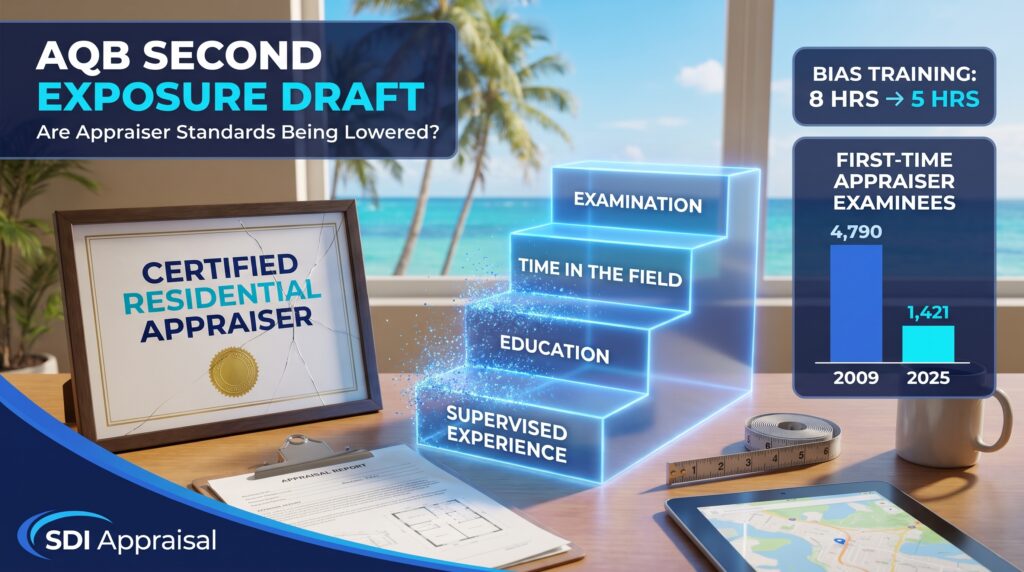
Two integrity and equity controls are weakened: the required valuation-bias and fair-housing course is shortened from eight hours to five and its repeating continuing-education version is made optional rather than required; and for mass-appraisal work, the experience log would no longer require a signature of any kind. Continuing education for the Trainee classification is dropped entirely.
The draft retains USPAP compliance, background checks, the national examination, and state oversight. Those retained layers matter, and this review does not pretend they are gone. The argument is narrower and more serious: the proposals net-weaken the qualification architecture at exactly the points where competence, seasoning, accountability, and fraud-resistance are actually produced.
Why the proposed criteria are insufficient
For the appraisal profession
Competence in valuation is not a fact retrievable from a textbook; it is judgment formed over time, against varied properties, in changing markets, under real pressure. The supervised experience model exists because mentorship transmits what an examination cannot test: how to defend an adjustment, how to handle a complex or atypical property, how to recognize a transaction that does not smell right, and — critically — how to say no to a client who wants a number. The Demonstration Appraisal Report Pathway removes that transmission entirely and substitutes three assignments designed and graded by a single approved entity. The draft's own description gives the game away: with "no comparable ongoing oversight," the candidate is certified on the basis of curated exercises rather than seasoned exposure to live engagements with real stakes.
The seasoning changes compound the problem. Removing the minimum-months spread, allowing the exam before experience, and letting a passing score never expire mean an appraiser can, in principle, pass an examination, complete a compressed block of experience, and enter independent practice carrying knowledge that is years stale and judgment that has never weathered a market cycle. Time in the work is not bureaucratic friction; it is how an appraiser sees a market turn, sees values that do not hold, and learns the difference. Compress the calendar and you have manufactured a credential holder who has the hours but not the seasoning.
The degree elimination is the most contestable single change, and a fair reviewer should say so plainly — the demonstrated job-relevance of a four-year degree to residential valuation is genuinely weak, and degree mandates are a real barrier. But the draft's logic, that the core curriculum and a multiple-choice examination already verify "analytical reasoning, quantitative literacy, and written-communication skills," asks a narrow, appraisal-specific instructional track and a standardized test to stand in for sustained analytical and written formation. That is a substitution of a thinner proxy for a thicker one, defended on the ground that the thicker one was imperfect. Removing a flawed safeguard is not the same as showing the residual safeguards are sufficient, and the draft does not carry that burden.
For the lending industry
Lenders, AMCs, and the government-sponsored enterprises do not independently re-verify each appraiser's competence on each loan; they rely on the credential as a portable proxy for trustworthy collateral valuation. That reliance is the credential's entire economic function. Dilute what the credential certifies and the risk does not disappear — it migrates downstream into more intensive appraisal review, more repurchase and buyback exposure, and heavier reliance on automated valuation models and appraisal waivers, which simply relocate the valuation risk rather than resolve it. This is happening against a backdrop in which GSE appraisal waivers are already expanding and a March 2026 executive order has directed agencies to "modernize" appraisal processes. Loosening qualification standards at the same moment the system is leaning harder on waivers and AVMs does not offset the erosion of collateral-valuation integrity; it stacks one erosion on top of another.
For the overall economy
Appraisal error is not idiosyncratic, the way one bad loan is idiosyncratic. Valuations feed mortgage origination, mortgages feed securitization, and securitized mortgages sit on bank balance sheets and inside the GSEs that the public ultimately backstops. Systematic under-qualification produces correlated valuation error — many appraisers making similar mistakes in the same direction at the same time, especially under volume pressure. That is the precise failure mode FIRREA was written to prevent in 1989 and the precise dynamic that inflated-collateral lending fed into the 2008 crisis. The standards exist because the externality is systemic: a mispriced appraisal harms not only the parties to that loan but the integrity of every instrument built on top of it.
Why a sufficient regulatory standard is what produces stability
It is tempting to treat qualification standards as a cost imposed on entry. They are better understood as a piece of market infrastructure that makes the whole edifice run. Every real-estate transaction is shot through with information asymmetry: the borrower, the seller, the agent, the broker, and the loan officer all have an interest in a high value, and none of them is positioned — or motivated — to certify an honest one. The appraiser is structurally the only disinterested party, and the qualification standard is what makes that disinterest credible to everyone downstream. A binding minimum competence floor is a trust technology. It lets millions of transactions clear without each counterparty individually re-investigating whether the person who signed the valuation knew what they were doing.
That is the stability function. Standardization reduces transaction costs in normal times and reduces tail risk in abnormal ones. And the standard matters most exactly when it is most tempting to relax it — in a boom, when volume spikes, turnaround pressure peaks, and the incentive to "hit the number" is at its highest. A floor that holds firm is counter-cyclical by design; it restrains the behavior that booms reward. Because the AQB sets a national floor that states must meet, that floor also prevents a competitive race to the bottom among states and among AMCs. Lower the floor and you do not just admit a few more entrants — you invite the very erosion the floor was built to stop, because in a cost-competitive market the minimum standard becomes the operative standard for everyone.
How "streamlining" operates as deregulation
The draft frames its cuts as the removal of requirements "not tied to practice readiness." The framing deserves scrutiny, because on paper removing redundancy and removing a safeguard look identical — both delete a requirement. The difference is whether the requirement was doing real work, and the burden of proof belongs to the party proposing removal. For several of these changes that burden is not met. Supervision, time-seasoning, coursework recency, signed documentation, and a meaningful bias curriculum are not idle box-checking; each is a control that an examination does not capture.
This is deregulation in substance whatever it is called in the preamble. And deregulation of a minimum-standard regime has a specific mechanism of harm: when the floor drops, the marginal entrant is less prepared, the states that merely meet the floor inherit the lower floor, and the cost-competitive AMC market gravitates toward the cheapest minimally-qualified appraiser it can engage. The floor becomes the ceiling. The reassurance that better-prepared appraisers may still pursue a degree or seek supervision voluntarily misunderstands how minimum standards function: voluntary excellence does not bind the market: the mandatory minimum does. What the AQB declines to require, the competitive market will decline to supply.
How this does not benefit the consumer
The consumer — the borrower and homeowner — is the party in the transaction least equipped to evaluate an appraiser's competence and most exposed to the consequences of getting it wrong. The borrower cannot read a credential's fine print, cannot tell a seasoned appraiser from a thinly-qualified one, and in many transactions never meets the appraiser at all. The credential is the consumer's only real assurance. Quietly thinning what it certifies transfers risk onto precisely the person who cannot see it and did not consent to it.
The harms run in both directions. An over-stated value leads a buyer to overpay, to over-leverage, and to land in negative equity that makes refinancing or selling difficult — the household-level version of the systemic collateral problem. An under-stated value kills a sale or denies credit a borrower qualifies for. Either way, the consumer absorbs the cost of valuation error, and then absorbs it a second time as a taxpayer standing behind the deposit-insurance funds and the GSEs.
The bias provisions sharpen the point. Appraisal bias — valuation outcomes that differ by the race or composition of a neighborhood or an owner — has been a front-burner federal concern, the subject of fair-lending enforcement and a dedicated interagency task force. At that exact moment, the draft proposes to cut the valuation-bias and fair-housing course from eight hours to five and make its continuing-education refresher optional. This is not a neutral efficiency. It reduces the preparation appraisers receive on the one harm that falls hardest on protected-class consumers, and it does so while marketing the package as consumer-friendly modernization. A reform that reduces bias training cannot honestly be presented as a reform for the consumer.
The shortage justification does not rescue the consumer case. The pipeline problem is real — first-time appraiser examinees have collapsed from roughly 4,790 in 2009 to about 1,421 in 2025, and the workforce is aging toward retirement. But a thinner credential does not get a consumer a good appraisal faster; it gets them a less-verified one. The consumer's interest is in a competent, independent valuation, not merely in a quickly-produced one. Lowering standards to widen the funnel trades a capacity problem the consumer can tolerate (a slower appraisal) for a quality problem the consumer cannot (a wrong one).
How this design allows for, and quietly promotes, fraud
Appraisal fraud is not exotic; it is a recurring, well-documented category — value inflated to support a predetermined loan, comparables cherry-picked to reach a target, "made as instructed" valuations produced under pressure from a loan officer or broker, and collusion among the parties to a transaction. The qualification framework is one of the layers that historically deters it, in two ways: by producing appraisers competent enough to recognize a manipulated valuation and ethically seasoned enough to refuse one, and by maintaining a documented, signed, traceable chain of accountability. Several proposals in this draft weaken both functions.
Removing supervision removes ethical inoculation. A supervisor models how to resist a client who wants a number and is jointly accountable for the trainee's work. An appraiser who enters through three curated demonstration reports has never been seasoned against live client or lender pressure and has had no mentor demonstrate refusal. A larger pool of supervision-light, thinly-seasoned appraisers is, structurally, a larger supply of practitioners who can be leaned on — which is the raw material of value-inflation fraud.
Concentrating verification in a single private gatekeeper creates a capturable choke point. Under the Demonstration Pathway, one AQB-approved entity sets the assignments, defines the review standards, and grades the work that alone determines whether a credential issues. That is a single point of failure and a pay-to-pass risk: if one entity is lax, captured, or corrupt, it can manufacture credentialed appraisers wholesale. Three reports on assignments the entity itself designs are not client work with real stakes; they are exercises that can be coached, gamed, or ghost-produced, with far less external friction than years of supervised engagements subject to a supervisor's independent sign-off and a state's review.
Stripping the signature requirement removes an anti-fraud control outright. For mass-appraisal experience, the draft eliminates the need for any signature on the experience log. Signatures are not ceremony; they are the mechanism by which someone attests, under accountability, that the claimed experience actually happened. Removing the attestation makes the qualification record itself easier to falsify — that is, it widens the door to credential fraud, the misrepresentation of experience to obtain a license one has not earned.
Stale knowledge weakens the fraud-detection node. Appraisers are not only valuers; they are one of the transaction's fraud-detection points, positioned to catch flips, undisclosed concessions, straw buyers, and manipulated comps. The combination of never-expiring exam scores, exam-before-experience, and compressed timelines can place an appraiser in independent practice with knowledge years out of date and minimal seasoning — less able to detect a fraudulent scheme and less able to resist being made part of one.
None of this means the draft "legalizes" fraud; USPAP, background checks, and state enforcement remain. The honest claim is narrower and still damning: the proposals remove friction and accountability that currently deter fraud, and they introduce a concentrated, capturable gatekeeper where none existed. In a cost-competitive market, removing friction from the path of least resistance is exactly how the marginal bad actor is accommodated. A system does not have to intend to promote fraud to promote it; it only has to make fraud cheaper, easier, and harder to trace. This draft does all three at the margin.
The strongest case for the draft, and why it does not carry
A credible critique must meet the best version of the other side. The capacity crisis is real and worsening; the supervisor bottleneck genuinely blocks willing entrants who cannot find anyone to train them; degree mandates have weak demonstrated job-relevance and disproportionately screen out capable candidates; and some of the draft's targets (an open elective block, a five-year coursework window that lacks an analogue at other levels) are plausibly low-value. The AQB is right that entry barriers untethered from readiness are worth scrutinizing, and right that the profession's pipeline cannot be ignored.
But the remedy is mismatched to the diagnosis. A pipeline problem — too few new entrants, an aging workforce, a supervisor shortage — is a capacity problem, and capacity problems are solved by investing in capacity: funding and scaling PAREA and practicum programs, subsidizing or incentivizing supervision, addressing appraiser compensation and AMC fee structures, and fixing the demand-side distortions that have hollowed out the trade. Lowering what the credential certifies does not build capacity; it redefines the shortage away by issuing more credentials that mean less. That trades a problem the system can absorb — appraisals that take longer — for one it cannot: appraisals that are wrong, biased, or bought. In collateral valuation, the quality problem is the expensive kind, and the public pays for it last and most.
Conclusion and recommendation
The Second Exposure Draft should not be adopted as written. Its central proposals lower a minimum standard that the entire lending and securitization apparatus relies upon, at a moment when the system is simultaneously expanding its dependence on waivers and automated valuation. It thins the formation of judgment that examinations cannot replace, compresses the seasoning that only time supplies, concentrates verification in capturable private gatekeepers, removes documentation controls that deter credential fraud, and reduces bias training that protects the most vulnerable consumers — all while assuring the public that the bar has not moved.
A sufficient standard is not an obstacle to a healthy appraisal profession; it is the precondition for one, and for the market stability that rests on it. The Board should retain the supervised-experience expectation and the time-seasoning and recency safeguards, decline to make any new pathway a wholesale substitute for supervised practice absent verification at least as rigorous, preserve rather than cut the valuation-bias curriculum, keep the signed accountability trail intact, and address the genuine capacity crisis through investment in the pipeline rather than reduction of the standard. The shortage is real. The answer is to build more appraisers, not to certify them as having learned less.
This review is offered as critical commentary on a public rulemaking draft and reflects the professional opinion of SDI Appraisal, LLC. It is not legal advice. Readers should refer to the AQB’s published exposure drafts and adopted criteria for authoritative language, and may wish to consult counsel or a qualified appraisal-regulatory professional on jurisdiction-specific questions.
SDI Appraisal Mission Statement
Committed to empowering our clients with clarity and direction.
Stephen D. Ihrig II, SRA is principal of SDI Appraisal, specializing in the valuation of residential real estate. Steve has been providing appraisal and consulting services since 2003. Currently a Certified Residential Appraiser in the State of Florida, Steve was awarded the SRA designation from the Appraisal Institute.
In today’s ever-changing real estate market, utilize only the best and most qualified individuals to perform your residential appraisals. An accurate value supported by data and analysis, that reflects market trends, can hold up in any court of law, is considered a high-quality report by any lender’s underwriting system, and meets all USPAP (Uniform Standards of Professional Appraisal Practice) standards should be your primary objective when retaining a real estate appraiser.
Specialized Professional Education and Development
- SRA Designation, Appraisal Institute
- Private Appraisal Assignments: Attorneys, Accountants, Property Owners, Trusts & other entities
- Expert Witness Testimony
- Real Estate Finance Statistics and Valuation Modeling
- Relocation Appraisal
- REO Appraisal: Appraisal of Residential Property Foreclosure
- FHA & USDA Approved Appraiser
- Uniform Standards of Professional Appraisal Practice (USPAP)
- Michigan State University Alumni