
Housing Policy · June 2026
An appraiser’s plain-English read on the 21st Century ROAD to Housing Act: the supply measures, the financing changes, and one provision tucked deep in the bill that speaks directly to how appraisals get done.
SDI Appraisal6 min read
Key takeaways
- Both chambers of Congress passed the 21st Century ROAD to Housing Act in June 2026 (Senate 85–5, House 358–32); it now awaits the President’s signature.
- The package bundles roughly 50 measures aimed at building more homes, easing financing, and modernizing federal housing programs.
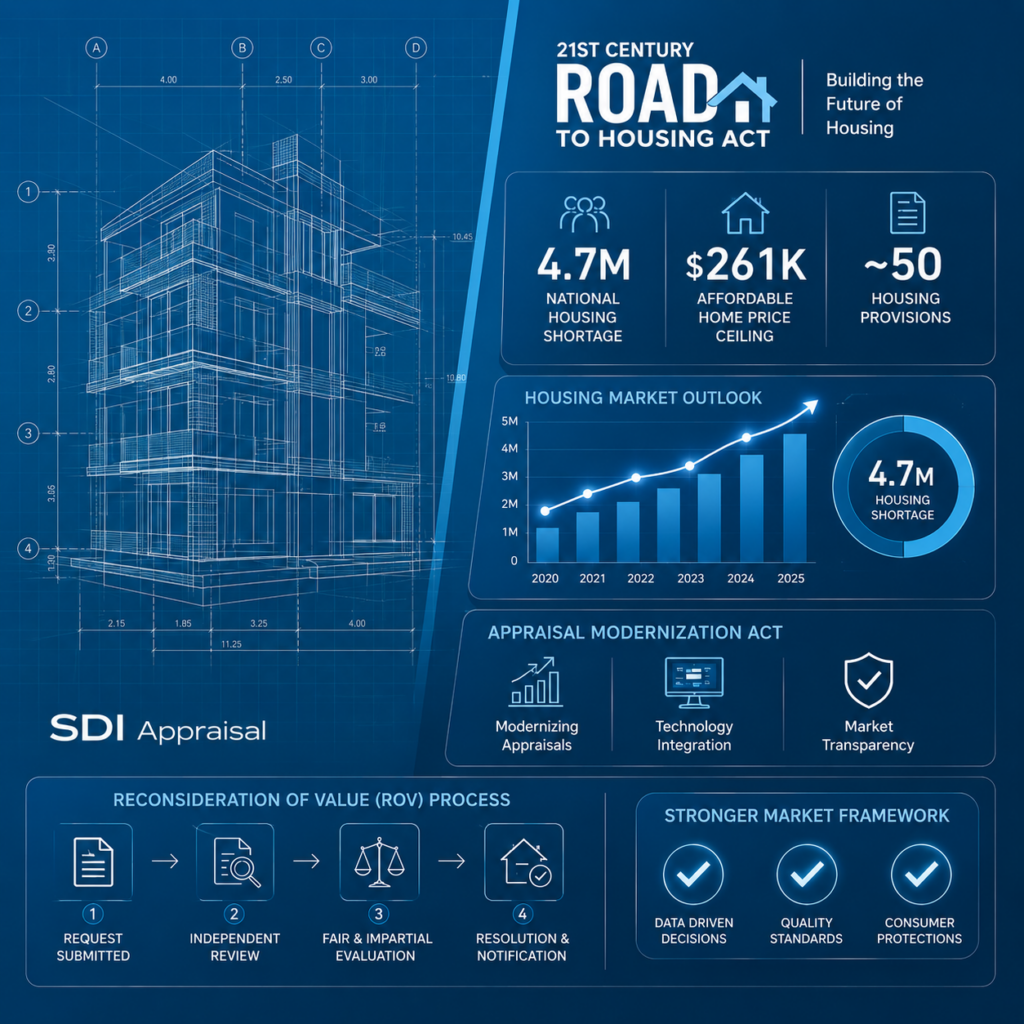
- It targets a reported national shortage of about 4.7 million homes, with the deepest gap at the affordable end of the market.
- A tucked-in Appraisal Modernization Act mandates formal reconsideration-of-value procedures and orders a study of a public appraisal database.
- Local impact on the Gulf Coast is real but long term — supply changes take years, not weeks.
Something rare happened in Washington this month: a deeply divided Congress agreed on something big. The Senate passed the 21st Century ROAD to Housing Act by a lopsided 85–5 vote, and the House followed 358–32. The bill now sits on the President’s desk awaiting signature. By most accounts it is the most consequential federal housing legislation in decades — the kind of broad, bipartisan package the housing world has not seen in a very long time.
As a firm that values homes for a living, we read through what is actually in this thing. Much of the coverage focuses on the headline goal — building more homes and making them more affordable — and that matters. But there is also a provision tucked deep in the bill that speaks directly to how appraisals get done, and almost nobody outside our corner of the industry is talking about it. We will get to that.
The core problem
The shortage the bill is trying to solve
The whole package is built around one stubborn fact: the country does not have enough homes on the market. After more than a decade of underbuilding, the National Association of REALTORS® estimates the United States is short roughly 4.7 million housing units. That gap is the engine behind a lot of what we have all watched unfold — bidding wars, rising prices, and would-be buyers who keep getting priced out, especially first-time and first-generation purchasers.
The squeeze is worst at the affordable end of the market. NAR research points to a shortage of around 310,000 homes priced at or below roughly $261,000 — exactly the inventory that working families and entry-level buyers depend on. When that supply is not there, buyers either fight over a shrinking pool of listings or step out of the market entirely.
The legislation
What’s actually in the package
Rather than one big idea, the ROAD to Housing Act bundles together close to 50 separate housing measures. Broadly, they fall into a few buckets.
Building more homes
A large share of the bill targets supply. It directs HUD to develop zoning and land-use best practices communities can use to clear barriers to development, streamlines environmental and federal reviews for smaller and infill projects, encourages preapproved building designs and faster local permitting, and supports converting vacant or abandoned buildings into housing. There is also a real push on manufactured, modular, and factory-built housing, modernizing the rules and easing the financing that has historically held those affordable options back.
Opening doors to ownership
Several provisions target the financing side. One creates a pilot program to expand access to small-dollar mortgages, loans of $100,000 or less, which have quietly become hard to get even though they are exactly what is needed to buy modest homes in many markets. Others examine the regulatory barriers that make those small loans uneconomical for lenders to originate in the first place.
Capital, veterans, and investors
The bill includes measures meant to strengthen lending capacity for affordable housing, plus provisions to make sure veterans are better informed about their VA loan benefits and to expand housing assistance for disabled veterans. It also includes a closely watched restriction on large institutional investors buying up single-family homes, though the final language was softened from earlier versions, and even housing economists are split on whether the restriction helps or hurts available supply.
For appraisers and homeowners
The part worth reading twice: the Appraisal Modernization Act
Here is the provision that did not make the press release but should be on every appraiser’s radar. Folded into the package is the Appraisal Modernization Act, and it does two notable things.
First, it requires the agencies behind federally backed lending — USDA, VA, FHA, and the FHFA — to put formal review-and-resolution procedures in place for borrowers who request a reconsideration of value (ROV) or a second appraisal. Many appraisers already work within ROV frameworks that lenders rolled out over the past couple of years, but this would standardize and federally mandate a defined path for consumers to challenge a valuation. If you do federally related work, expect ROV handling to become a more formal, more uniform part of the engagement rather than something that varies lender to lender.
Second, it directs the Government Accountability Office to study the feasibility of a public appraisal database that would consolidate valuation data currently held separately by the FHFA, HUD, USDA, and the VA. That is just a study for now — not a database, and not a mandate — but it signals where policymakers are looking, and it is worth watching as the report develops.
Appraisal practice is part of the affordability conversation in Washington now, and the trend is toward more standardization, more transparency, and more consumer recourse.
Status check
Where the bill stands right now
One honest caveat, because this is still developing. The bill has passed both chambers of Congress, but as of publication it has not yet been signed into law. The path to the President’s signature hit a last-minute snag, so while the legislation is widely expected to become law, the exact timing is unsettled. Here is the sequence so far:
Drafted and merged
House and Senate housing proposals were combined into a single bipartisan package earlier in 2026.
Senate passage
The Senate approved the measure 85–5 with broad bipartisan support.
House passage
The House followed the next day, 358–32, sending the bill to the President.
Awaiting signature
The bill is now on the President’s desk; signing timing is currently unsettled.
Agency implementation
Once signed, federal agencies will spell out how each provision, including the appraisal rules, actually works. This is where the practical details land.
We will update this article once the bill is officially signed and once the agencies begin detailing how the appraisal provisions will be implemented.
Local lens
Why this matters on Florida’s Gulf Coast
For buyers and sellers across our service area, the long-term promise here is more inventory and a few more realistic on-ramps to ownership, though none of it happens overnight. Zoning reform, permitting changes, and new construction take years to show up as homes you can actually walk through. This bill does not fix affordability this season; it tries to change the trajectory.
For Manatee & Sarasota County buyers and sellers
Expect the near-term picture to look much like today’s, with the policy tailwind building slowly underneath it. If you are pricing a sale or planning a purchase, current comparable sales and local conditions still drive value far more than federal headlines do — which is exactly where an accurate, independent appraisal earns its keep.
For appraisers and lending partners
The message is simpler: stay current. The reconsideration-of-value framework is tightening up, data transparency is on policymakers’ minds, and the appraisal is increasingly treated as part of the affordability equation rather than a back-office formality. SDI Appraisal will keep tracking how implementation unfolds and what it means for the work we do here.
Why SDI Appraisal
Independent, local, and built for accuracy
Policy shifts in Washington are worth understanding, but value is decided street by street. SDI Appraisal delivers credible, well-supported residential valuations grounded in the realities of Florida’s Gulf Coast market — the kind of work lenders, attorneys, agents, and homeowners can rely on when the number has to be right.
When the new reconsideration-of-value standards take effect, you will want an appraiser who already documents thoroughly and responds professionally. That is the standard we hold ourselves to on every assignment.
Frequently asked questions
What is the 21st Century ROAD to Housing Act?
It is a bipartisan federal housing package that bundles close to 50 separate measures aimed at increasing housing supply, lowering barriers to construction, expanding access to homeownership, and modernizing federal housing programs. It is widely described as the most significant housing legislation Congress has passed in decades.
Did the housing bill pass, and is it law yet?
Yes. Both chambers of Congress passed the bill in June 2026 — the Senate approved it 85–5 and the House followed 358–32. It became law in July 2026 without the President’s signature after the 10-day window for action expired. Federal agencies are now working on implementation.
How will the bill affect home prices and affordability?
The bill targets the root cause of high prices — a national housing shortage of roughly 4.7 million homes — by streamlining reviews, encouraging zoning reform, and supporting more construction. The effects are long term. Zoning changes, permitting reform, and new construction take years to translate into homes buyers can actually purchase, so it is designed to change the trajectory of affordability rather than lower prices immediately.
What does the Appraisal Modernization Act change for appraisals?
Folded into the package, the Appraisal Modernization Act requires the agencies behind federally backed lending — USDA, VA, FHA, and the FHFA — to put formal review-and-resolution procedures in place for borrowers who request a reconsideration of value or a second appraisal. It also directs the Government Accountability Office to study the feasibility of a consolidated public appraisal database.
What is a reconsideration of value (ROV)?
A reconsideration of value is a formal process that lets a borrower or other party ask the appraiser to review an appraised value, typically by submitting additional information such as overlooked comparable sales or corrections to property details. The new law would standardize how lenders handle these requests across federally backed loan programs.
How does this affect buyers and sellers on Florida’s Gulf Coast?
For buyers and sellers in Bradenton, Sarasota, and the surrounding Manatee and Sarasota County communities, the long-term promise is more inventory and more realistic paths to ownership. The near-term effect is modest because supply changes take years to appear. On the valuation side, expect reconsideration-of-value handling to become more formal and uniform.
When will the changes take effect?
Timing depends on signature and then on agency rulemaking. Once the bill is signed, federal agencies must spell out how each provision, including the appraisal rules, will be implemented. That implementation phase is when the practical details land, and it typically unfolds over months.
Get in touch
Need a valuation you can stand behind?
Whether you are buying, selling, refinancing, or settling an estate on Florida’s Gulf Coast, SDI Appraisal delivers independent, well-documented residential appraisals. Have a question about how any of this affects your transaction? We are happy to talk it through.
Request an appraisalRead more insightsSDI Appraisal Mission Statement
Committed to empowering our clients with clarity and direction.
Stephen D. Ihrig II, SRA is principal of SDI Appraisal, specializing in the valuation of residential real estate. Steve has been providing appraisal and consulting services since 2003. Currently a Certified Residential Appraiser in the State of Florida, Steve was awarded the SRA designation from the Appraisal Institute.
In today’s ever-changing real estate market, utilize only the best and most qualified individuals to perform your residential appraisals. An accurate value supported by data and analysis, that reflects market trends, can hold up in any court of law, is considered a high-quality report by any lender’s underwriting system, and meets all USPAP (Uniform Standards of Professional Appraisal Practice) standards should be your primary objective when retaining a real estate appraiser.
Specialized Professional Education and Development
- SRA Designation, Appraisal Institute
- Private Appraisal Assignments: Attorneys, Accountants, Property Owners, Trusts & other entities
- Expert Witness Testimony
- Real Estate Finance Statistics and Valuation Modeling
- Relocation Appraisal
- REO Appraisal: Appraisal of Residential Property Foreclosure
- FHA & USDA Approved Appraiser
- Uniform Standards of Professional Appraisal Practice (USPAP)
- Michigan State University Alumni